I’m a game designer focused on building systems that feel meaningful and responsive to player choice. I’ve worked on a range of projects, from narrative-driven tabletop campaigns to Unity-based tools like procedural terrain systems. I enjoy working across design, scripting, and prototyping, and I’m especially interested in how mechanics and storytelling come together to shape player experience.
Explore My Work
Procedural Terrain Generation ATI (Unity)
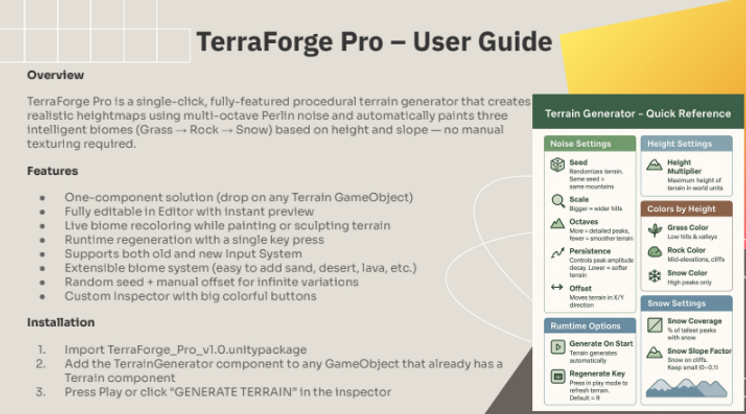
A custom Unity tool that auto-generates terrain to speed up level prototyping and gameplay iteration, allowing me to focus on refining mechanics and player experience.


Mechanics + Theme Emphasis
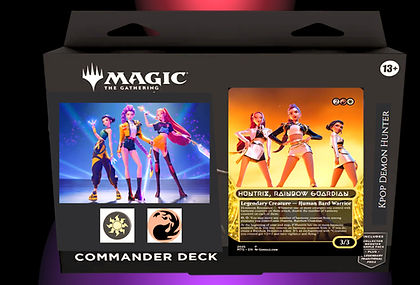
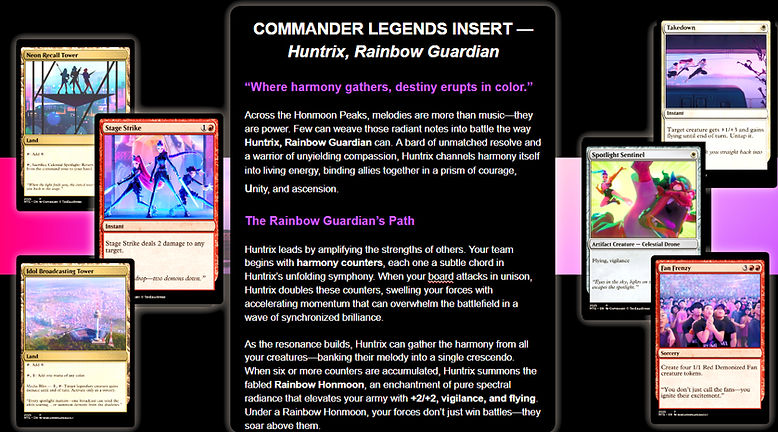
I designed a custom Magic: The Gathering Commander deck built around a K-Pop Demon Hunter concept, blending strong thematic identity with mechanical synergy. Every card choice reinforced the core fantasy — high-energy performance masking supernatural combat — ensuring gameplay and narrative flavor worked together.
Narrative Design
Tabletop Campaign
Development
Building on the thematic backbone of The Dark Tower, I crafted a D&D campaign that wove character choice into a larger mythic structure. Encounters, world rules, and progression mechanics were designed to reinforce the setting’s atmosphere of inevitability and consequence.

Case Study: Procedural Terrain Generation API (Unity)
Role
Project Owner, Design Lead
Focus
System Design • Mechanics Design • Player Experience
Overview
Designed and developed a fully playable 100-card Commander deck for Magic: The Gathering, centered around three original custom commanders. The goal was to create a cohesive system that combined unique mechanics, strong thematic identity, and practical playability within the constraints of the Commander format.
Challenges
Balancing multiple custom commanders within a single deck created complexity early on. Each character had distinct mechanics, but ensuring they worked together without overwhelming the player or causing conflicting strategies was difficult. Additionally, maintaining proper deck balance while keeping the card pool accessible added another layer of constraint.
Solution
The design was unified through a shared mechanic—harmony counters—which connected each commander’s playstyle into a cohesive system. Interactions were simplified to keep gameplay readable, with a focus on cards that reinforced token generation, combat synergy, and resilience. Commonly available cards were prioritized, and the final deck was formatted for Moxfield to support easy testing and real play use.
Outcome
The final result was a balanced, fully functional Commander deck with a clear identity and smooth gameplay flow. Players can build a wide board, scale their strength through synergy, and stay protected against disruption. The system feels cohesive, easy to understand, and engaging to play, successfully blending creative design with practical implementation.
Case Study: Mechanics + Theme Emphasis
Role
Project Owner, Systems Designer, Developer
Focus
Unity Development • Procedural Systems • Optimization
Overview
Developed a procedural terrain generation system in Unity designed to create dynamic and replayable environments. The goal was to build a flexible tool capable of generating varied terrain efficiently and consistently.
Challenges
The initial system suffered from performance issues and repetitive output. Terrain generation was computationally heavy, causing slowdowns, and generated environments often lacked visual and structural variety.
Solution
I optimized generation logic by reducing unnecessary calculations and improving how terrain data was stored and reused. I also introduced variation rules and parameter tuning to ensure more natural and diverse environments across runs.
Outcome
The final system delivered improved performance and significantly more environmental variety. It became a stable, scalable procedural tool suitable for larger and more complex projects.
Case Study: Narrative Design Tabletop Campaign
Role
Project Owner, Design Lead
Focus
Narrative Design • Player Choice • System Structure
Overview
Designed and developed an original tabletop campaign focused on player-driven storytelling and meaningful choices. The goal was to create a system where player decisions had clear and lasting impacts on the world and narrative.
Challenges
Early in development, player clarity was a major issue. Some mechanics and narrative paths were too complex, making it difficult for players to understand how their decisions influenced the game. This slowed gameplay and reduced engagement.
Solution
I simplified core systems and restructured how information was presented to players. I added clearer decision feedback through in-world consequences so outcomes were easier to recognize. Ongoing playtesting helped identify confusion points and refine the experience step by step.
Outcome
The final version delivered a smoother gameplay experience and significantly improved player engagement. Players felt more confident in their decisions and had a clearer understanding of how their actions shaped the narrative world.
Portfolio



The Exit Alone video game is set in a science facility
in which the experiments have taken over and is on
the verge of complete lock down. Players will need to
work together to defeat enemies that lurk within
while searching for the 3 security keys they need to
escape. The first player to get 3 keys must try to exit
before the other players attempt to sabotage their
escape and take the keys for themselves. Although
the players must work together, only one will exit
and win the game.


Why I built this tool:
I noticed that Unity’s built-in terrain tools are incredibly powerful but extremely tedious for
anything beyond flat or basic hills. Most students (including myself early on) spend hours painting textures by hand, and the results still look artificial. I wanted to create a tool that removes 95% of that friction while still giving full artistic control.
Core Design Goals:
1. Zero setup – drop on any terrain and it just works
2. Instant feedback – change a slider → see result immediately
3. Professional quality out of the box (proper biome blending, slope-aware snow)
4. Extensible – the BiomeLayer class makes adding new materials trivial
5. Educational value – clean, commented code that teaches Perlin noise, splatmaps, and editor scripting
Technical Highlights I’m Proud Of
● Live color updates while painting (using SceneView mouse drag detection)
● Custom Inspector with big obvious buttons (professors love this)
● Clean separation between height generation and texturing → super fast iteration
● Works in both Edit and Play mode without hiccups

The world of Mid-World, inspired by Stephen King’s The Dark Tower series, is a land where time has broken, technology and magic intertwine, and forgotten histories shape the present. The Tower, the linchpin of all existence, is under threat, and only those brave enough to traverse the decaying paths of the Beam can hope to save reality. Players will explore the remnants of Gilead, the wastelands of Thunderclap, and the haunting depths of the Dixie Pig, encountering both horrors and wonders as they uncover the mysteries of the Tower.




Connect with Me
Let’s Collaborate
Interested in discussing a project or providing feedback? Reach out to me, and I’ll respond promptly to explore potential collaborations.